
5 MBA Application Mistakes That Cost You an Admit (And How to Avoid Them) – MIT LGO Insights Included
Unni Krishnan • 15th January, 2026
Your GMAT score is 720+. Your GPA exceeds the median. Your resume boasts impressive work experience. Yet your MBA application rejection arrives anyway. This isn't a story of insufficient talent. It's a story of preventable mistakes.
While many MBA application tips focus on what you should do, this guide exposes the critical errors admissions committees see repeatedly. These mistakes quietly cost even strong candidates their admits. Based on insights from top-tier MBA application strategies and direct feedback from MIT LGO admissions, here are five MBA application mistakes that distinguish admitted candidates from rejected ones, plus concrete frameworks to avoid them.
Mistake #1: Building a Generic Narrative That Could Fit Any School
What It Looks Like:"I want an MBA to advance my career, gain leadership skills, and expand my network. With an MBA, I'll transition into management and drive organizational change."
This opening appears in thousands of applications each cycle. It's competent. It's professional. It's forgettable.
Why It Fails:Admissions committees don't reject candidates for lack of ambition. They reject them for lack of clarity. Generic narratives signal that you haven't invested time in self-reflection about why an MBA matters to you specifically. When your "why" could apply to any candidate at any school, the committee questions whether you've genuinely thought through the decision.
For MIT LGO specifically, this mistake is magnified. LGO isn't a standard MBA. It's a 2-year dual degree combining engineering, operations management, and business strategy. If your narrative reads like a traditional MBA essay, admissions officers immediately recognize that you haven't researched what makes LGO unique: the technical coursework, the operations focus, the 6-month partner internship, and the leadership development grounded in engineering systems thinking.
How to Fix It:Replace generic motivation with authentic narrative. Ask yourself: "Why this MBA right now, and why does this specific program align with where I want to go?"
For MIT LGO applicants: Research LGO's technical essay component. Identify a technical challenge you solved and explain how LGO's operations management courses, particularly Six Sigma, systems optimization, and supply chain strategy, directly build on that experience. Name specific LGO outcomes: "I want to move from engineering IC to operations leadership, which LGO's partner internship in manufacturing operations will enable."
Real-World Example:
Weak: "I want to develop leadership capabilities and transition into management."
Strong: "As a supply chain analyst at a pharmaceutical company, I identified $2M in inefficiencies through process mapping, but lack the systems-thinking framework to scale this impact across operations. LGO's combination of lean manufacturing, systems design, and strategic operations, plus the internship with partner companies, directly prepares me to move into operations leadership within the first three years post-graduation."
Mistake #2: Burying Leadership Impact Under Technical Jargon
What It Looks Like:Resume bullet: "Developed Python-based ETL pipeline to automate data ingestion from heterogeneous sources, enabling real-time analytics across microservices architecture and reducing computational overhead by 40%."
Why It Fails:Admissions officers reading your resume ask one question: "Will this person add value to the classroom and thrive post-MBA?" Dense technical language obscures the answer. When jargon dominates your resume, the file reviewer can't quickly extract what you did, what you decided, and what you influenced.
This is particularly damaging for engineering backgrounds, precisely the demographic applying to MIT LGO. Many engineers assume that the complexity of their work speaks for itself. It doesn't. Admissions committees need to see leadership, the ability to simplify, communicate, and drive outcomes, not just technical depth.
How to Fix It:Lead with outcomes. Translate jargon into accessible language that highlights impact, decision-making, and influence.
Real-World Example:
Technical Jargon: "Architected microservices migration framework using containerized deployment patterns and implemented CI/CD automation, reducing deployment cycles from 6 weeks to 2 days."
Leadership Impact: "Led cross-functional team of 8 to redesign deployment process, reducing release cycles from 6 weeks to 2 days. This acceleration enabled product team to ship features twice as frequently and directly contributed to 25% revenue growth in Q4."
For MIT LGO Applications:Your technical essay should bridge technical depth with leadership. Show how you solved a technical problem and led people through that solution. Adcoms want to see that you can operate fluently in both engineering and business contexts, exactly what LGO develops.
Mistake #3: Copy-Pasting Essays Across Schools (Or Forgetting School Names)
What It Looks Like:Essay prompt: "Why do you want to attend MIT LGO?"
Your answer: "MIT's world-class faculty, rigorous curriculum, and global network make it an ideal choice for business leaders committed to continuous learning and operational excellence."
Swap "MIT" for "Stanford" and the essay still works. That's the problem.
Why It Fails:This mistake signals to admissions committees that you haven't done your homework. It reads as either rushed or insincere. In competitive admissions, lack of genuine interest is a fast-track rejection reason.
For MIT LGO, this error is particularly costly because the program is distinctive. If your essay doesn't reflect understanding of LGO's unique positioning, dual degree structure, engineering department integration, operations management specialization, and partner companies, it's obvious you're copy-pasting.
Red Flag Example Admissions Committees Spot Instantly:A candidate writes about wanting to study finance at a program that doesn't offer a finance track, or talks about LGO's global exchange when emphasizing domestic operations focus.
How to Fix It:Invest time in genuine research. Move beyond the website FAQ.
LGO-Specific Research Strategy:
- Visit lgo.mit.edu and review department-specific engineering courses, case study partners (Procter & Gamble, Eaton, other manufacturers), and alumni career paths
- Watch MIT LGO student testimonials on YouTube (like Emma Shortall's application tips video)
- Attend LGO information sessions or virtual student chats
- Review specific LGO courses you'd take in your chosen engineering department
- Identify one partner company you're particularly interested in and explain why their operations challenge aligns with your goals
Real-World Example, Strong MIT LGO Essay:"MIT LGO's integration of mechanical engineering coursework with operations management directly addresses my career gap. As a manufacturing engineer at XYZ company, I've seen brilliant technical solutions fail due to poor implementation and supply chain misalignment. LGO's systems thinking approach, particularly the supply chain optimization and lean manufacturing tracks, combined with the mandatory 6-month internship at a tier-1 manufacturing partner, positions me to transition from design engineering into operations leadership."
Mistake #4: Choosing Recommenders by Title, Not Relationship
What It Looks Like:You ask your VP (whom you see quarterly) to write your recommendation because the title sounds impressive, rather than your direct manager (whom you work with daily) who knows your actual performance.
Why It Fails:A lukewarm or generic recommendation from a senior executive who barely knows your work does more damage than no recommendation at all. Admissions committees can instantly detect hollow recommendations. They read thousands of them and spot when a recommender lacks specific examples or firsthand knowledge of your impact.
The Real Cost:Even a strong profile collapses when recommendation letters are vague. Admissions committees cross-check: Does what your recommender says align with your resume, essays, and goals? If the recommendation reads generic or contradicts your narrative, it raises credibility questions.
How to Fix It:
Step 1: Choose recommenders who know your day-to-day work (ideally supervisors or direct collaborators from the past 18-24 months).
Step 2: Brief them strategically. Don't script their letter, but provide context:
- Your MBA goals and career trajectory post-MBA
- 2-3 specific examples of your leadership, impact, or problem-solving
- How your candidacy for this program differs from other MBA candidates
Step 3: For LGO specifically, emphasize technical problem-solving plus team leadership examples. LGO wants to see both dimensions, not just technical skill or management alone, but the integration of both.
Recommender Brief Template:"In your letter, I'd appreciate it if you could touch on how I approached the [specific project], particularly the way I collaborated with [team/department] to solve [challenge]. This experience directly shaped why I'm committed to operations management as my post-MBA focus."
Mistake #5: Inconsistency Across Application Components
What It Looks Like:
- Resume says: "Led cross-functional team of 12"
- Essays say: "I struggled with delegation early in my career"
- Recommender letter says: "Excellent individual contributor, prefers working independently"
- Interview comment: "I'm most proud of my team leadership"
These contradictions create cognitive dissonance for admissions committees.
Why It Fails:Admissions readers move quickly, typically 7-10 minutes per application. They're pattern-matching: Does this person have a coherent narrative? Can they explain themselves consistently? Inconsistency triggers questions about self-awareness, honesty, or preparation. It doesn't need to be a dramatic contradiction. Subtle misalignment creates doubt.
Application Red Flags Admissions Committees Spot Instantly:
Resume-Goal Mismatch: Resume shows finance experience; essays discuss operations passion
Timeline Gaps: You list continuous employment but your background essay mentions a 6-month gap you don't address
School-Specific Language That Doesn't Fit: You reference LGO's "finance specialization" when LGO focuses on operations and supply chain
Recommender Tone Misalignment: Recommender writes in first-person narrative (unusual, suggests applicant drafted it) or uses tone/vocabulary dramatically different from recommender's usual style
How to Fix It:Create a "narrative anchor document" before writing any application component.
Narrative Anchor Template:
- Core story (2-3 sentences): "I'm a supply chain analyst transitioning to operations leadership. Technical background plus demonstrated impact designing processes. Seeking MBA to build business acumen and systems thinking."
- Key themes (3-4): Operations excellence. Systems thinking. Technical plus business integration. Leadership through influence.
- Supporting stories (5-6): Specific projects that demonstrate these themes
- Post-MBA vision: Clear, specific, and realistic
Before writing essays, resume, or briefing recommenders: Check every component against this anchor. Does it reinforce the core narrative?
Red Flags Adcoms Notice Instantly (And How to Avoid Them)
Admissions committees develop finely-tuned pattern recognition. Here's what triggers immediate concerns:
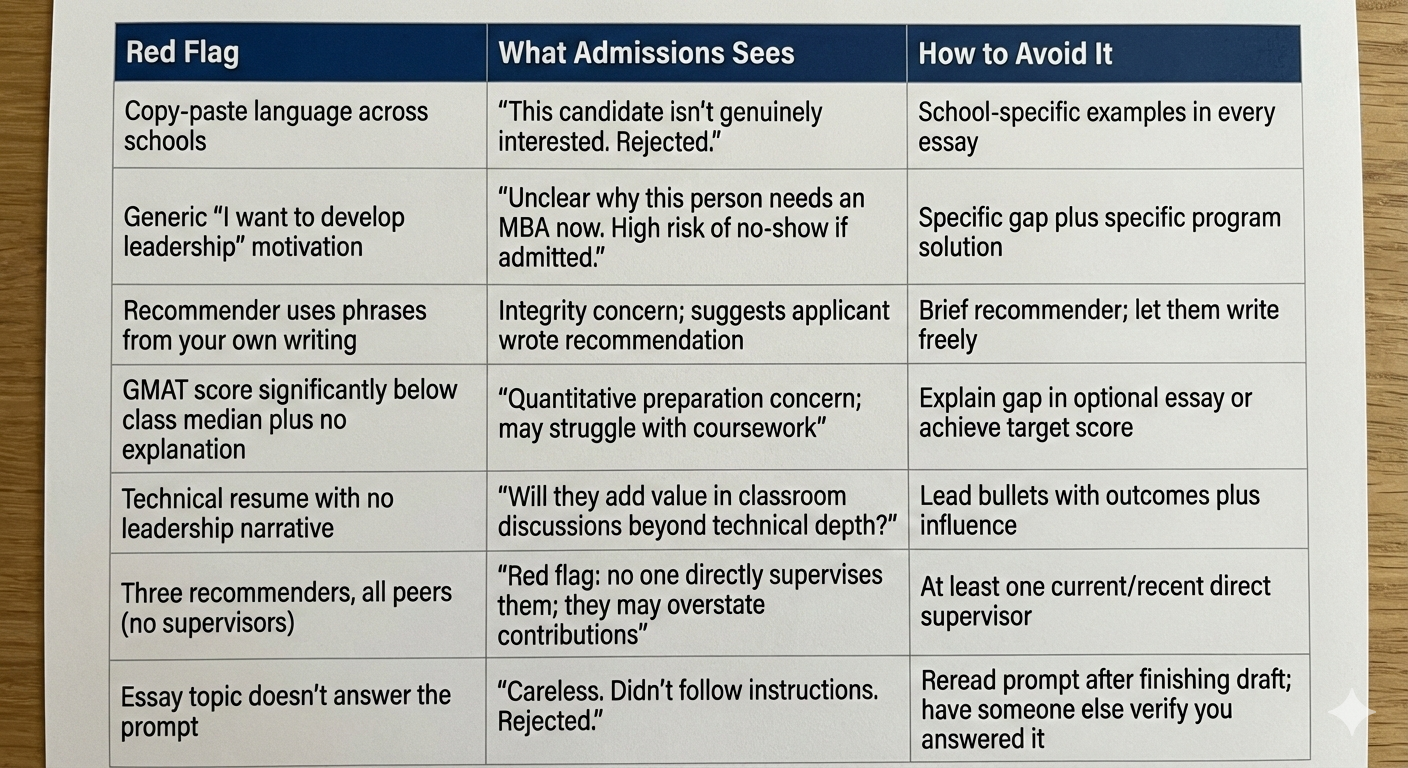
Framework: Before You Submit Your Application—Final Checklist
Essay & Narrative Review (24 hours before submission):
- Reread the prompt. Does your essay directly answer the question, or do you veer off-topic?
- Remove generic phrases ("I want to grow as a leader," "gain valuable experience"). Replace with specific outcomes.
- Check for school specifics. If you swap the school name and the essay still works, rewrite it.
- For MIT LGO: Have you demonstrated understanding of the dual degree structure, engineering department, and operations focus?
Resume & Consistency Check:
- Verify all dates (employment, education, certifications) match across application sections
- Convert jargon into outcome statements (what changed because of your work?)
- Does your resume narrative align with your essays' stated goals? (If essays emphasize operations leadership, does a resume show relevant progression?)
Recommender Alignment:
- Do your recommenders' bullet-pointed contributions align with themes in your essays?
- Is the recommended language consistent with their typical voice? (If a VP suddenly writes like your own LinkedIn, that's a red flag.)
MIT LGO-Specific Checks:
- Technical essay: Did you frame a technical challenge AND describe how you led others through the solution?
- Department selection: Explicitly state which engineering department and why (with research evidence)
- Optional essay: If you have any gaps (employment, GPA, grade retake), did you address them concisely?
- 1-minute introduction video: Does it show personality and authenticity, or does it feel overly polished and corporate?
MIT LGO Interview Prep: Quick Question Block
If your application advances to the interview stage, expect questions designed to assess technical depth plus business thinking. Here's what LGO interviewers typically ask and how to prepare:
Question Type 1: Technical Problem-Solving"Tell me about a technical challenge you faced and how you approached it."
Strong Answer Framework:Context (30 sec) → Challenge (30 sec) → Your Solution (1 min) → Business Impact (30 sec)
Example: "In my role as a process engineer, we had a manufacturing bottleneck in assembly causing 15% scrap rates. I mapped the process flow, identified that the issue was tool vibration at a specific station, and proposed a $50K equipment upgrade with a 9-month payback period. The team was skeptical initially, but I modeled the cost-benefit analysis and got buy-in. Post-implementation, scrap dropped to 2%, saving $1.2M annually."
Question Type 2: Why LGO? Why Now?"What specifically about MIT LGO appeals to you versus other MBAs?"
Strong Answer:Reference 2-3 specific program elements. "LGO's dual-degree structure in mechanical engineering plus operations management directly addresses my gap. Most MBAs lack technical depth; most engineering programs lack business strategy. I'm drawn to the partner company internship because working at [specific company] on [specific operations challenge] will ground my learning in real-world manufacturing."
Question Type 3: Diversity & Community"How will you contribute to the LGO cohort?"
Strong Answer:Show you've researched LGO's culture. "LGO values diversity of thought. My background as [industry/function] combined with experience in [region/discipline] brings a perspective that could enrich discussions around [specific LGO focus area: supply chain, product design, operations efficiency]."
Conclusion: Your Path Forward
MBA application mistakes aren't about intelligence or qualification. They're about clarity, consistency, and genuine engagement. The difference between an admit and a rejection often comes down to whether you've invested time in understanding what this specific program needs and what you specifically bring.
For MIT LGO applicants, the stakes are even higher. LGO is selective precisely because it seeks a rare combination: technical rigor plus business acumen plus leadership readiness. Admissions committees are assessing whether you understand that integration and whether you're genuinely prepared for it.
The five mistakes outlined here, generic narrative, buried impact, copy-pasted essays, weak recommenders, and inconsistency, are entirely avoidable. The candidates who get admitted aren't necessarily smarter than those rejected. They are simply more intentional.
Next Step: Audit your application components right now against the checklist above. If you find gaps, fix them before submission. The difference between a rushed application and a polished one is visible to admissions officers in seconds. It costs admits.
Your MBA application tips start here: Know yourself, know the program, be consistent, and show up fully. That's how strong candidates become admits.
FAQ:
1: Is it better to have a high recommender by title or a mid-level recommender who knows me well?Mid-level recommender, always. Admissions committees prioritize specific examples and credibility over titles. A detailed, warm letter from someone who directly supervised you beats a generic letter from a senior executive every time.
2: How many schools should I apply to?Quality over quantity. 3-5 schools, fully tailored, outperform 10 schools with copy-paste essays. Each "why this school?" essay should demonstrate genuine engagement.
3: Should I explain a low GMAT/GPA in the optional essay?Yes, if there's genuine context (illness, family emergency, work crisis during the relevant period). No, if there's no external explanation. "I didn't study hard enough" isn't a viable excuse. If your scores are genuinely below target, retake the test or apply in a later round.
4: For MIT LGO, which engineering department should I choose?Choose based on your career goals and background, not brand perception. If you're in electrical engineering but your post-MBA goal is manufacturing operations, mechanical engineering may be the better fit. Research faculty, course offerings, and partner internship placements for each department.
5: How much should I rely on an admissions consultant vs. doing this myself?Self-reflection and authentic storytelling are non-negotiable (you do those). External feedback on clarity, consistency, and competitive positioning is extremely valuable. Even strong applicants benefit from expert eyes identifying gaps or contradictions they can't see themselves.
← Return home