
From Ordinary to Extraordinary: A Strategic MBA Resume Guide for Ivy League Applicants
Unni Krishnan • 9th January, 2026
Most MBA candidates do not utilize their resumes to their full potential. They list roles like a grocery checklist, hide impact behind corporate jargon, and leave admissions officers unclear about who they are or what they have achieved.
This ultimate MBA resume guide changes that. It shows you the exact system that got candidates into Harvard, Wharton, MIT, and Stanford. Not because they had perfect careers but because they understood how to tell that story on paper.
Your MBA resume has one job: make admissions officers believe you'll contribute meaningfully to their program and thrive afterward.
Why Your MBA Resume Is Different (And Why It Matters)
The MBA resume template you find online isn't built for business school admissions. It's built for recruiting.
Job recruiters scan for skills. Admissions officers scan for something different:
- Will you add to classroom discussions? (They want diverse perspectives and real experience.)
- Can you lead? (Not just manage tasks, but actually influence outcomes.)
- Do you understand yourself? (Why you're here, where you're going, what you've learned.)
- Are you ready for the next chapter? (Do your achievements show growth? Do they ladder toward your stated goals?)
A typical resume answers what you did. An MBA resume that works answers who you've become.
Your Positioning Statement: The Invisible Foundation
Before you write a single bullet point, create a positioning statement. Never put it on your resume but write it down and keep it in front of you while you work.
This statement forces you to be clear:
- What's the concrete achievement you're most proud of?
- What challenge or limitation did that achievement reveal?
- What does your MBA goal represent?
Here's an example: "I've spent five years optimizing supply chain processes and saved my company millions. But I realized my technical expertise means nothing without understanding operations strategy and cross-company systems. That's why I want an MBA—to move from doing excellent work in isolation to leading operations teams that compound across organizations."
Now, every bullet on your resume either reinforces this narrative or gets deleted. Simple as that.
Building Your MBA Resume: Structure That Wins
Here's the structure admissions officers recognize and respect:
Your Name | City | Phone | Email | LinkedIn
Keep it minimal. No photo, no graphics, no personal website unless it's truly exceptional. The focus is your work, not your aesthetic choices.
Professional Summary (2-3 sentences, optional but smart)
This is where you set the frame for everything below. Think of it as your elevator pitch distilled.
"Operations-focused engineer with 5 years driving measurable process improvements worth $15M+. Built cross-functional teams and translated complex technical solutions into business outcomes. Seeking MBA to deepen strategic operations expertise and lead at the director level."
That's it. You've positioned yourself in 45 seconds.
Professional Experience (the bulk)
Go reverse chronological. For MBA candidates, lead with recent roles—the last 5 years matter most. You can summarize older roles or skip them entirely if they don't support your narrative.
For each role:
- Company name and location
- Your title and dates
- 3-4 bullet points (rarely more)
Education
List your degree, university, graduation year. Include GPA only if it's 3.8+ or significantly above your target program's median. Below median? Omit it. Admissions have your transcript anyway.
Skills (brief, strategic)
8-10 core competencies that matter for your MBA goals and future career. Not a laundry list—a carefully chosen set.
For operations: Process optimization | Supply chain management | Six Sigma | Cross-functional leadership | Systems thinking | Data analysis | Lean manufacturing
For tech: Technical architecture | Engineering leadership | Scalability | Cloud infrastructure | Data-driven decision making | Team development
See how these skills tell a story? They're not random—they're the story.
Awards or Certifications (if relevant)
Only include if they're actually interesting to admissions officers. "Employee of the Month" from 2019? Skip it. "Six Sigma Black Belt"? Include it.
The Bullet Point Framework That Changes Everything
This is where your MBA resume either shines or disappears.
Most candidates write: "Responsible for process improvement and team management."
That tells admissions officers nothing. They've seen 10,000 bullets like that.
Here's what actually works: Action → Context → Impact.
You led something specific. There was a reason it mattered. And something measurable changed.
Real-World Before & After
Operations/Supply Chain:
"Managed supply chain optimization and efficiency improvements."
"Led cross-functional team of 8 (manufacturing, quality, supply chain) through complete assembly workflow redesign. Identified three critical bottlenecks using fishbone analysis and data mapping. Reduced cycle time from 6 days to 4 days, improved on-time delivery from 87% to 96%, and generated $1.2M in annual cost savings."
Why the second one works: You see the action (led a team, used specific methodology), the context (what problem you were solving), and the concrete impact (specific metrics). Admissions officers reading this think: This person understood what mattered and made it measurable.
Finance/Strategy:
"Responsible for budget planning and financial analysis."
"Partnered with VP and CFO to redesign annual budgeting process for $200M business unit. Consolidated 40+ disconnected data sources into automated dashboard. Cut budget cycle from 12 weeks to 6 weeks, enabling leadership to make strategic decisions 6 weeks earlier. Improved forecast accuracy by 18%, preventing $4M in potential overages."
The specificity changes everything. You sound like someone who thinks about systems, not someone checking boxes.
Technology/Engineering:
"Developed data infrastructure and led engineering initiatives."
"Architected real-time analytics pipeline processing 2B+ data points daily for 150+ internal teams. Led 6-person engineering team through migration from batch processing to streaming infrastructure. Reduced query latency by 60%, cutting cloud costs by $450K annually. Mentored 3 junior engineers; 2 promoted to senior roles within 18 months."
Notice what you're doing: painting a picture of impact at scale, leadership, and systems thinking.
Consulting/Client Work:
"Worked on multiple client engagements across different industries."
"Led team of 5 on supply chain optimization engagement for $400M pharmaceutical manufacturer. Analyzed 18 months of operational data, identified 12 major inefficiencies through root cause analysis and process mapping. Presented findings and recommendations to C-suite. Client approved $8M implementation roadmap; delivered in 14 months, generating $2.1M in documented savings and operational improvements across three facilities."
You're showing: complex problem-solving, client management at C-suite level, concrete deliverables, measurable results. That's how you get noticed.
MBA Resume Examples by Career Track
Your field matters. Admissions officers expect different things depending on your background.
If You're in Operations or Supply Chain
They want to see: systems thinking, cost impact, cross-functional leadership.
"Optimized inventory model for 12-facility manufacturing network serving $600M in annual revenue. Developed statistical forecasting model using historical demand data, reducing excess inventory by 22% ($8M savings) while improving fill rates from 91% to 97%. Coordinated across manufacturing, logistics, and sales to implement changes. Results became template adopted by all 12 facilities."
If You're in Technology or Engineering
Show: technical depth married with business outcome and leadership.
"Led 8-person team to redesign mobile app architecture supporting 50M+ monthly active users. Identified performance bottleneck affecting user retention. Implemented new caching strategy and database optimization, reducing app load time from 3.2 seconds to 1.1 seconds. User retention improved from 42% to 51% month-over-month. Changes delivered 2 weeks ahead of deadline, enabling holiday launch."
If You're in Finance
Demonstrate: strategic thinking, P&L impact, cross-functional influence.
"Managed P&L for 6-department business unit ($85M annual budget). Redesigned cost allocation methodology, revealing true profitability by function for the first time. Identified $5.2M in cost reduction opportunities through zero-based budgeting. Secured CFO approval and led implementation across all departments over 8 months. Improved overall unit profitability by 12%."
If You're in Consulting
Show: client impact, scope of influence, measurable outcomes.
"Led digital transformation engagement for Fortune 500 financial services company ($1.5M project). Designed and implemented new customer data platform reducing marketing cost-per-acquisition by 32%. Coordinated across 4 departments and external vendors. Findings informed company's $50M strategic investment in customer analytics. Delivered 3 weeks early, earning renewal for Phase 2 engagement."
If You're in Healthcare or Nonprofit
Emphasize: mission impact, stakeholder management, outcome measurement.
"Led program redesign for community health initiative serving 35K patients annually. Partnered with clinical, operations, and finance leadership to streamline patient intake and scheduling. Reduced average wait time from 50 minutes to 18 minutes. Patient satisfaction scores improved from 68% to 88%. Operational improvements generated $1.8M in efficiencies, funding expansion to 2 additional locations."
If You're an Entrepreneur
Focus on: growth trajectory, resourcefulness, team building.
"Founded and scaled B2B SaaS platform from $0 to $3.2M ARR in 3 years. Built customer base from zero to 110+ enterprise clients including Fortune 500 companies. Raised $7.5M in Series A funding from top-tier investors. Grew team from 3 founding members to 42 people while maintaining 94% annual customer retention. Personally closed 40% of initial enterprise contracts through relationship-building and consultative selling."
ATS Compatibility and Keyword Integration
Here's the reality: some schools still use Applicant Tracking Systems. Your resume needs to work for both algorithms and humans.
Format that passes ATS:
- Standard fonts (Arial, Calibri, Times New Roman)
- No tables, graphics, or text boxes
- Standard headings (Professional Experience, Education, Skills)
- Simple bullet points (• or -)
- Clear company names and job titles
Keywords that matter (use naturally):
If you're operations-focused: Process optimization, supply chain, cost reduction, efficiency, Six Sigma, lean manufacturing, operations management, cross-functional, systems thinking.
If you're tech-focused: Technical leadership, scalability, system architecture, cloud infrastructure, engineering team, code quality, automation, performance optimization.
If you're finance-focused: Budget management, financial analysis, cost reduction, P&L, forecasting, revenue growth, financial planning, strategic decision-making.
The key is weaving these in naturally. Your bullets should hit these keywords organically because you're talking about the real work you did.
Making Numbers Tell Your Story (Ethically)
Numbers make resumes memorable. But they must be true.
What you should absolutely quantify:
- Financial impact (savings, revenue, budget managed)
- Operational metrics (time, efficiency, error reduction, quality)
- Scale (team size, users, customers, geographic reach)
- Growth (percentage improvement, expansion, market share)
- People impact (team members managed, promotions developed, retention)
What to be careful about:
- If you contributed to a $100M project but led a small piece of it, say so. "$12M of the $100M supply chain project" is honest. "$100M project" is misleading.
- If you "helped" someone else's initiative, don't claim it as your own impact.
- If you genuinely achieved something significant, own it. "Led initiative that generated $2.1M in savings" is better than "assisted with cost reduction efforts."
When numbers aren't available:Be specific about what changed. "Reduced onboarding time significantly" is weak. "Reduced onboarding from 6 weeks to 3 weeks" is strong. "Streamlined 12-step process to 6 steps" is concrete.
Keeping Your Resume in Sync With Your Application
Your MBA resume lives alongside your essays, LinkedIn profile, and recommendations. They should all tell the same story.
Quick alignment check:
- Do your bullet points align with your positioning statement?
- Do your bullets support your stated career goals?
- Does your LinkedIn profile tell the same story (same dates, same company names, compatible descriptions)?
- Will your recommenders reference the same accomplishments?
- Do your essays explain the narrative connecting your resume to your MBA motivation?
If there's a mismatch, admissions officers catch it. Not in a "gotcha" way—but it makes them question your self-awareness and honesty.
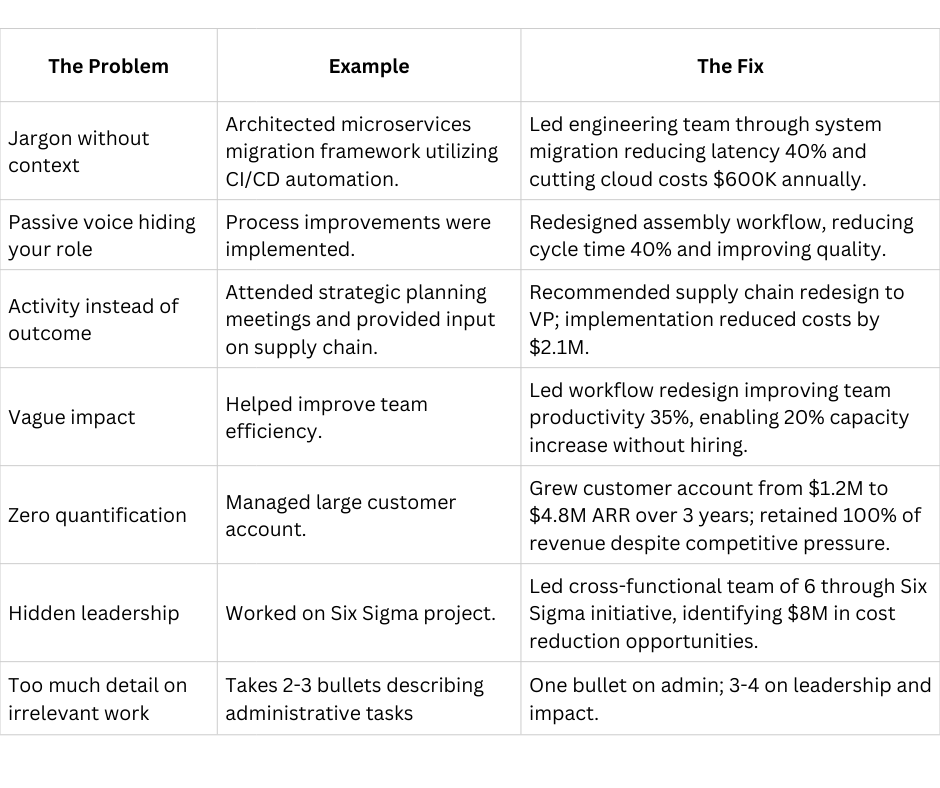
Mistakes That Cost You Admissions (And How to Fix Them)
Your MBA Resume Audit Checklist
Content Quality:
- Does each bullet follow Action → Context → Impact format?
- Is every major accomplishment quantified (numbers, percentages, or specific metrics)?
- Do bullets show leadership, influence, or strategic thinking—not just task completion?
- Does my resume reinforce my positioning statement and career narrative?
- Would an admissions officer understand my trajectory and MBA motivation?
Format & Presentation:
- Is this a clean, scannable one-page (or two if 15+ years experience)?
- Are fonts standard and ATS-friendly?
- Are dates consistent across my resume, LinkedIn, and application?
- Are company names and job titles clear and accurate?
- Could I hand this to someone unfamiliar with my background and they'd understand what you've accomplished?
Keywords & Optimization:
- Does my resume include relevant industry keywords (supply chain, tech leadership, finance, etc.)?
- Are leadership verbs used naturally (led, built, directed, grew, transformed)?
- Are outcome words present (improved, reduced, increased, generated, achieved)?
- Do my keywords align with my MBA program's focus and my stated goals?
Alignment Check:
- Do my resume bullets support the career goals stated in my essays?
- Does my LinkedIn profile tell a consistent story?
- Will my recommenders reference the same accomplishments?
- Is there any contradiction between my resume and my application essays?
Final Thoughts
Your MBA resume is admissions officers' first impression of you as a professional. It's where you prove that you understand yourself, can articulate impact, and know where you're going.
The candidates who get in aren't necessarily the ones with the most impressive titles. They're the ones who understand their narrative and can tell it compellingly on paper.
Start with your positioning statement. Build every bullet around what you actually did, why it mattered, and what changed. Make your numbers real. Let your leadership show. Be specific.
That's how ordinary careers become extraordinary on paper.
And that's how you get in.
FAQ:
1. Should I include my GPA?
Only if it's genuinely strong (3.8+). If you're in the 3.5-3.7 range and your program's median is lower, include it. Otherwise, leave it off. Schools have your official transcript; this isn't where they'll learn your GPA.
2. How far back should an MBA resume go?
Lead with your strongest recent experience (5 years). If you have relevant experience from 5-10 years ago, include it. Anything older than 10 years can be summarized or omitted unless it's relevant to your narrative. Quality matters more than quantity.
3. What's the difference between an MBA fresher resume and an experienced candidate resume?
An MBA fresher resume (0-3 years experience) shows initiative, early wins, and clear MBA motivation despite limited seniority. An experienced candidate's MBA resume (5+ years) shows career progression and increasing impact. Both must demonstrate leadership relative to their level and quantified results.
4. Should I use a Harvard MBA resume template or Wharton MBA resume template?
These templates are starting points, not prescriptions. Use them for format and structure, but customize the content. Your resume should tell YOUR story using YOUR accomplishments, not a template's examples.
5. How do I address a career gap or job transition?
Your resume states facts (dates, titles, outcomes). Explain context in your optional essay or cover letter: "I took 6 months after my first role to assess where I wanted to focus, then deliberately moved into operations where my engineering background could have strategic impact."
6. What if I don't have huge numbers to show?
Use specific metrics that matter: process improvements, efficiency gains, quality metrics, team size, scope of responsibility. "Reduced defect rate from 3.2% to 1.1%" is concrete even if the financial impact isn't stated. "Led team of 5" shows scope. Be honest about what you accomplished.
7. Should I include volunteer work or side projects?
Only if they're meaningful and show leadership or impact. "Volunteered at a local nonprofit" doesn't cut it. "Founded nonprofit program serving 200 students; grew from 10 to 15 volunteer mentors; 92% of mentees pursued college" shows real impact.
← Return home