
Ivy League Athletic Recruiting 2025: The Complete Guide
Unni Krishnan • 15th December, 2025
Straight to the point. This guide is for student-athletes and families navigating the Ivy League recruiting process. It covers academic requirements, financial aid, timelines, and actionable steps for 2025 applicants. The difference between getting recruited and being invisible often comes down to knowing the rules of the game before it is too late.
So here’s the question everyone asks:
Do Ivy League schools actually offer athletic scholarships?
The answer is no. They do not.
This is the single most important fact in Ivy League athletic recruiting, and it shapes everything that follows.
Unlike schools such as Duke, Stanford, or Ohio State, Ivy League colleges explicitly do not offer athletic scholarships for any sport. What they offer instead is need-based financial aid, the same system used for non-athletes. These prestigious colleges, also known as Ivy League institutions, are renowned for their academic excellence and unique financial aid policies that set them apart from other universities.
Here’s what that means in practice:
Your sport does not pay your tuition.
Financial aid is based entirely on family income and assets.
Coaches cannot offer or negotiate money. They can only guide families through the financial aid process after admission.
That reality changes how recruiting works at Ivy League schools as part of the broader college admissions process.
Coaches evaluate academic fit, character, and long-term contribution alongside athletic ability. Talent matters, but it is not enough. Strong academics are not optional. They are critical.
This guide breaks down exactly how Ivy League athletic recruiting works in 2025, and what families need to understand to avoid being overlooked.
Understanding the Academic Index (AI)
The AI is the gatekeeper. It determines whether a coach can even recruit you. Each Ivy League school sets a 'minimum AI'—the lowest Academic Index score that student-athletes must meet to be eligible for recruitment, and this threshold can vary by institution.
What Is the Academic Index?
The AI is a numerical score (60-240) used by Ivies to ensure recruited athletes maintain academic standards comparable to the overall applicant pool. It’s not secretive—it’s how they ensure fairness.
No matter how talented you are athletically, if your AI falls significantly below the recruited athlete average, coaches cannot recruit you. This isn’t a guideline. It’s a rule. The AI is specifically designed to uphold the high academic expectations of Ivy League schools, ensuring that all student-athletes meet rigorous academic requirements.
How Is It Calculated?
The formula combines three components:
- GPA (Weighted or Unweighted) – Worth up to 80 points
- SAT scores and other standardized test scores (such as ACT) – Worth up to 80 points
- Class Rank (If available) – Worth up to 80 points
Schools without class rank shift more weight to standardized test scores.
What's the Realistic Range?
Here’s the reality. The average SAT score for Ivy League athletes varies significantly by school:
- Harvard, Yale, Princeton: Average AI 220+ (SAT 1480+)
- Penn, Columbia, Cornell: Average AI 200+ (SAT 1400-1450)
- Brown, Dartmouth: Average AI 190+ (SAT 1350-1400)
Your target? GPA 3.8 or higher. At top Ivies, recruited athletes with 3.5 GPAs are rare exceptions—usually extraordinary athletes in limited sports.
Why? Because at Ivy League schools, academics matter as much as athletics. Non-negotiable. A candidate's academic achievements, especially strong performance in challenging coursework, are a critical factor in the athletic recruiting process.
How Do Ivy League Athletes Actually Pay for School?
So how do Ivy League athletes pay for school? This is where most people are confused. It’s completely different from other D1 programs—and frankly, better than most think. Unlike other schools, Ivy League institutions do not offer academic or athletic scholarships or any form of athletic money. Instead, they rely solely on need-based financial aid, which is determined and awarded by the institution's financial aid office.
Ivy League schools meet 100% of demonstrated financial need. Here’s the breakdown:
Here’s what surprises people: the package, managed exclusively by the financial aid office, is often better than full athletic scholarships offered elsewhere.
The Ivy League Recruiting Timeline
This part of the process causes more confusion than almost anything else in Ivy League athletics.
Families often assume recruiting decisions happen late, or that offers arrive suddenly at the end of high school. In reality, the Ivy League recruiting timeline follows a very specific sequence, known as the Ivy League recruiting process, which is a distinctive set of steps unique to these schools.
Let’s break down when things actually happen and how coaches evaluate prospects at each stage of the overall recruiting process.
Freshman & Sophomore Years (Grades 9-10)
Most people think nothing important is happening here. They’re wrong.
What you should be doing:
- Build your GPA to 3.8+
- Take challenging high school classes to strengthen your academic profile
- Compete at state, national, or international levels
- Create an athletic resume with statistics and wins
- Start highlight reels on Hudl or YouTube
Some coaches identify talent in sophomore year. Being on their radar early matters.
Junior Year (Grade 11)
June 15. NCAA permits direct coach-to-recruit communication. Expect emails. The NCAA (National Collegiate Athletic Association) governs college sports and sets recruiting rules for all Division I programs, including the Ivy League.
Between June 15 and end of junior year:
- Attend Ivy League camps and showcases
- Take SAT/ACT early (submit by fall senior year)
- Polish highlight reel to 90 seconds to 2 minutes (game footage only)
- Email coaches proactively with Academic Index, GPA, test scores, achievements
Some athletes may make a verbal commitment to a coach during junior year, indicating their intention to join the program.
Most recruited athletes reach out first. Coaches don’t find every athlete.
Senior Year (Grade 12)
October 1–March 15: This is the “likely letter” window—when recruiting decisions happen. A likely letter is an early notification from admissions indicating a high probability of acceptance, contingent on continued academic and personal performance.
September 15: Complete applications by this date for likely letters by October 1.
November 1: Early Action/Early Decision deadline.
After submitting your application, you will receive your official decision on the appropriate notification date, which may include a formal admission offer from the school.
Keep your grades up. Fall senior year GPA actually matters.
What Are Likely Letters?
A likely letter is a non-binding communication from Ivy admissions indicating you’re highly likely to be admitted, provided academics don’t change. Likely letters signal that you are highly likely to gain admission if your academic and personal record remains strong.
Key facts:
- Sent between October 1–March 15 (strictly regulated)
- Non-binding but 99% reliable – Not technically a guarantee, but practically? You’re in.
- 2/3 to 3/4 of Ivy athletes receive them – Standard for recruited athletes
- Replaces athletic scholarships – How Ivies compete without scholarships
- Only the admissions office has the authority to issue a likely letter, making it an official communication after reviewing your application.
Your coach submits your profile and provides admissions support throughout the process, helping you navigate requirements and increasing your chances of receiving a likely letter. However, only the admissions office is responsible for making final admissions decisions. Coaches recommend; admissions decides.
How to Communicate With Ivy League Coaches
Coaches don’t find every athlete. This is important. Some athletes have to find coaches.
Most recruited athletes reach out first. Not the other way around. Balancing athletic commitments with proactive communication to coaches is crucial—student-athletes must manage their training schedules while consistently reaching out to programs of interest.
Step 1: Build Your Digital Presence
- Hudl profile – Include stats, highlights, achievements
- LinkedIn – Keep it professional (coaches check)
Step 2: Email Coaches (The Right Way)
Email template:
__
Coach [Name],
_I'm [Your Name], a [position/sport] at [High School] in [City, State]. I'm interested in playing for [School] and combining athletics with a rigorous education. _
Here's where I stand:
- GPA: 3.9 | SAT: 1420 | Class Rank: Top 5%
- [Key athletic achievement]
- [Tournament placement]
I'm attaching my highlight reel and athletic resume. I'd welcome discussing how I can contribute to your program.
Best regards,
[Your Name] [Phone] [Email]
Keep it short. Coaches receive hundreds of emails.
Step 3: Follow Up
- Email 5-10 coaches at schools where your academics are competitive
- As a prospective student athlete, follow up after 2-3 weeks if you receive no response
- Attend official visits and camps where coaches see you in person
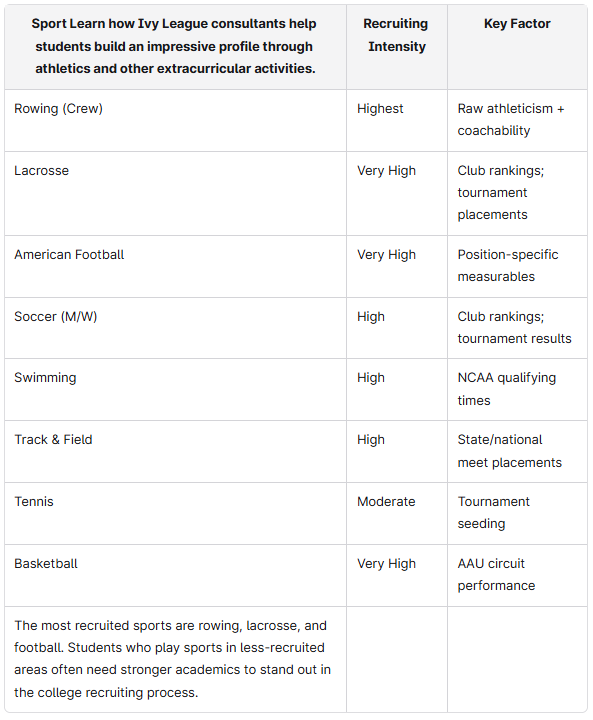
Sport-Specific Recruiting Standards
Ivy League athletes play sports at the highest college level sports, competing in athletic programs that are both historically significant and highly competitive. Each athletic program evaluates talent based on the standards and needs of their respective sports, making the recruitment process unique for every team.
Different sports have different emphases, just as Ivy League schools have different acceptance rates:
What's Changing in 2025
Digital Scouting. Coaches rely on video analysis and Hudl statistics. A polished highlight reel increases visibility dramatically.
Social Media Matters. Coaches review Instagram, TikTok, and LinkedIn. One controversial post can hurt you.
International Recruiting. Ivy Leagues actively recruit from Canada, Australia, India, and Europe. This is your moment if you’re international.
NIL for Ivy Athletes. NIL (Name, Image, and Likeness) refers to student-athletes' rights to profit from their personal brand and endorsements. Unlike other D1 schools, Ivy League schools do not directly pay athletes through NIL deals. But you can pursue independent NIL opportunities with companies (deals over $2,000 require attestation).
Earlier Recruitment. Some coaches identify talent in sophomore year now.
Character Matters. Leadership, resilience, and team fit are weighted equally with athletic performance.
The Ivy League annually finishes among the top NCAA Division I conferences in national competitive rankings, reflecting its commitment to both academic and athletic excellence.
How to Stand Out (The 4-Part Formula)
Exceptional Academics (Non-Negotiable)
- GPA: 3.8+ minimum
- Test scores: 1350+ (ideally 1400+)
- AP/IB classes matter
- Strong academic performance—including high GPA, test scores, and a challenging course load—is essential for Ivy League athletic recruiting. Without strong academics, coaches cannot recruit you. This is a rule.
- Ivy League schools are renowned for their academic prestige and offer a rigorous college education that prepares student-athletes for success beyond sports.
Proven Athletic Excellence
- National or state-level placement
- Summer/club competition dominance
- Consistent improvement
- Game film showing technique and awareness
- For student athletes seeking Ivy League athletic recruiting, demonstrating exceptional athletic talent is crucial, as coaches prioritize both proven performance and potential. Ivy League student athletes are expected to excel not only in their sport but also academically, reflecting a unique combination of academic and athletic excellence.
Strategic Coach Outreach
- Personalized emails to 5-10 schools
- Ivy League schools recruit student-athletes through proactive outreach, evaluating talent via showcases, camps, and direct communication with prospective recruits
- Official visits and camps
- Clear communication of interest
- Professional follow-up
Compelling Athletic Narrative
- In essays and interviews, answer: Why this sport? What challenges have you overcome? How do you contribute to team culture?
- Coaches want athletes who embody resilience and character—not just talent. At Ivy League schools, athletics are considered a significant educational component of the undergraduate experience, demonstrating your ability to balance rigorous academics with high-level sports.
Common Mistakes (And How to Avoid Them)
- Assuming your sport alone gets you in. A 3.6 GPA with incredible talent gets rejected.
- Waiting for coaches to find you. Most recruited athletes reach out first.
- Poor-quality highlight reels. Coaches want game footage, not music montages.
- Applying before coach pre-support. Coaches should indicate support before you submit.
- Ignoring financial aid questions early. Ask coaches about expected family contributions early.
- Applying to schools below your Academic Index range. Apply where you’re genuinely competitive.
- Neglecting academic responsibilities while focusing on athletics. Balancing your athletic pursuits with your academic responsibilities is crucial, especially in the demanding environment of Ivy League schools.
- Not taking challenging courses during secondary school. Ivy League athletic recruiting values a rigorous academic background, so be sure to take challenging courses throughout secondary school.
- Overlooking the value of community service in strengthening your application. Community service is an important extracurricular that can enhance your overall profile and demonstrate personal strengths.
Your Personal Recruiting Roadmap
Freshman / Sophomore Year
- Build a strong GPA (aim for 3.8+)
- Compete at state or national level events
- Start creating a highlight reel
Junior Year (Spring)
- Finalize SAT or ACT
- Begin emailing college coaches after June 15
- Attend college camps and showcases
Junior Year (Summer)
- Compete at the national level
- Refine and update your highlight reel
- Build consistent relationships with coaches
Senior Year (Fall)
- Submit applications by September 15
- Target likely letters
- Attend official campus visits
Senior Year (Spring)
- Make your final decision
- Commit to the program
Explore how excelling in niche sports and athletics could become your secret Ivy League advantage and help your college application stand out this year.
In a nutshell:
Look, Ivy League athletic recruiting in 2025 is brutally competitive. But it’s not a mystery.
The schools want exceptional athletes who are also exceptional students. Getting recruited requires strategic thinking, early preparation, and persistent outreach.
Ivy League schools share a unique commitment to both academic and athletic excellence, setting them apart from other schools and athletics conferences. Unlike other schools, Ivy League institutions participate in NCAA Division I athletics but do not offer athletic scholarships, instead focusing on need-based financial aid. This dual emphasis on academics and athletics is a hallmark of the Ivy League’s reputation.
Don’t wait for coaches to find you. Don’t assume your sport is enough. Don’t apply to schools where your Academic Index is below the recruited athlete range.
Instead:
- Build elite academics (GPA 3.8+, SAT 1400+)
- Earn athletic credentials through national-level competition
- Reach out to coaches with personalized outreach
- Craft a compelling narrative about why you belong
- Get pre-support from coaches before applying
Your Ivy League athletic recruiting journey starts today.
FAQ
What’s the difference between recruited athletes and walk-ons?
Recruited athletes have coach support in admissions before applying, significantly boosting candidacy. Walk-ons are admitted through regular admissions and earn roster spots through tryouts after arriving on campus. A walk-on is a student-athlete who joins a college team without being formally recruited or receiving coach support during admissions.
Can I get recruited as a walk-on if coaches don’t contact me?
Extremely unlikely at Ivies where rosters are small. If a coach wanted you, they would’ve contacted you by junior year.
Do Ivy League schools offer any athletic scholarships?
No—Ivy Leagues explicitly prohibit athletic scholarships. All athletes receive need-based aid only, which is often better than scholarships elsewhere.
What if I don’t receive a likely letter?
Not receiving one doesn’t mean rejection; some recruited athletes aren’t sent likely letters due to admissions timing. Many admitted athletes never received one.
When can I commit to an Ivy League school?
Most recruited athletes commit during Early Decision in November/December after receiving a likely letter. Early Decision is binding.
How important is summer performance?
Very important—Ivy coaches scout heavily at summer competitions and camps where they see you competing at the highest level.
Will being international hurt my recruiting chances?
No. Ivy Leagues actively recruit internationally from Canada, Australia, India, and Europe to increase diversity.
Can coaches guarantee admission?
No, only admissions can admit. But a coach’s strong endorsement makes admission nearly certain.
What SAT score do I need for Ivy League recruiting?
The average SAT score for Ivy League athletes ranges from 1350 (lower Ivies) to 1480+ (Harvard/Yale/Princeton). Aim for 1400+.
How do NCAA Academic Performance Ratings impact Ivy League athletic recruiting?
Ivy League schools place strong emphasis on NCAA Academic Performance Ratings, which reflect a student-athlete’s academic achievements and commitment. High ratings demonstrate to coaches and admissions that you can balance rigorous academics with athletics, making you a more attractive recruit.
What is the history and significance of intercollegiate sports in the Ivy League?
Intercollegiate sports have a long tradition in the Ivy League, dating back to the 19th century. These athletic programs were among the first in the nation, helping to shape the culture and values of Ivy League schools by emphasizing both academic and athletic excellence.
← Return home